Three lessons on AI for business leaders from Martin Eriksson and Barry O'Reilly
By CJ Daniel-Nield - 5 June 2026
5 Min Read
TL;DR: Leaders are feeling the pressure to figure out how AI can benefit their business: pressure to cut costs, do more with less, and show results fast. The leaders finding value are doing three things: leading the behaviour change themselves, pointing AI at bigger problems (not cheaper versions of existing ones), and using AI to amplify the moats their business already has.
Three takeaways for business leaders:
Lead the behaviour change. Don't ask your team to use AI if you're not using it openly yourself.
Go after bigger problems, not cheaper versions of existing ones, by using AI as an opportunity to reimagine the value you provide.
Use AI to surface your business's edge. The biggest opportunity isn't AI itself: it's what AI enables in the moats you already have.
For a lot of leaders right now, AI feels pretty doom-and-gloom. There’s pressure to have a strategy, pressure to cut costs, pressure to do more with less, and pressure to show results.
But history tells us to believe a more hopeful story. Ten years ago, Geoffrey Hinton (the godfather of deep learning, who later won the Nobel Prize) told the world to stop training radiologists. AI was going to replace them within five years. AI really did change medical imaging. But there are now 60% more radiologists in the US than there were ten years ago.
That's what economists call Jevons paradox: when the cost of something falls, demand goes up, not down. AI made imaging cheaper and faster, and we now do far more of it. The same will be true with AI. More problems worth solving, and more people needed to solve them.
So what does this opportunity mean for business leaders, and what should you be doing about it?
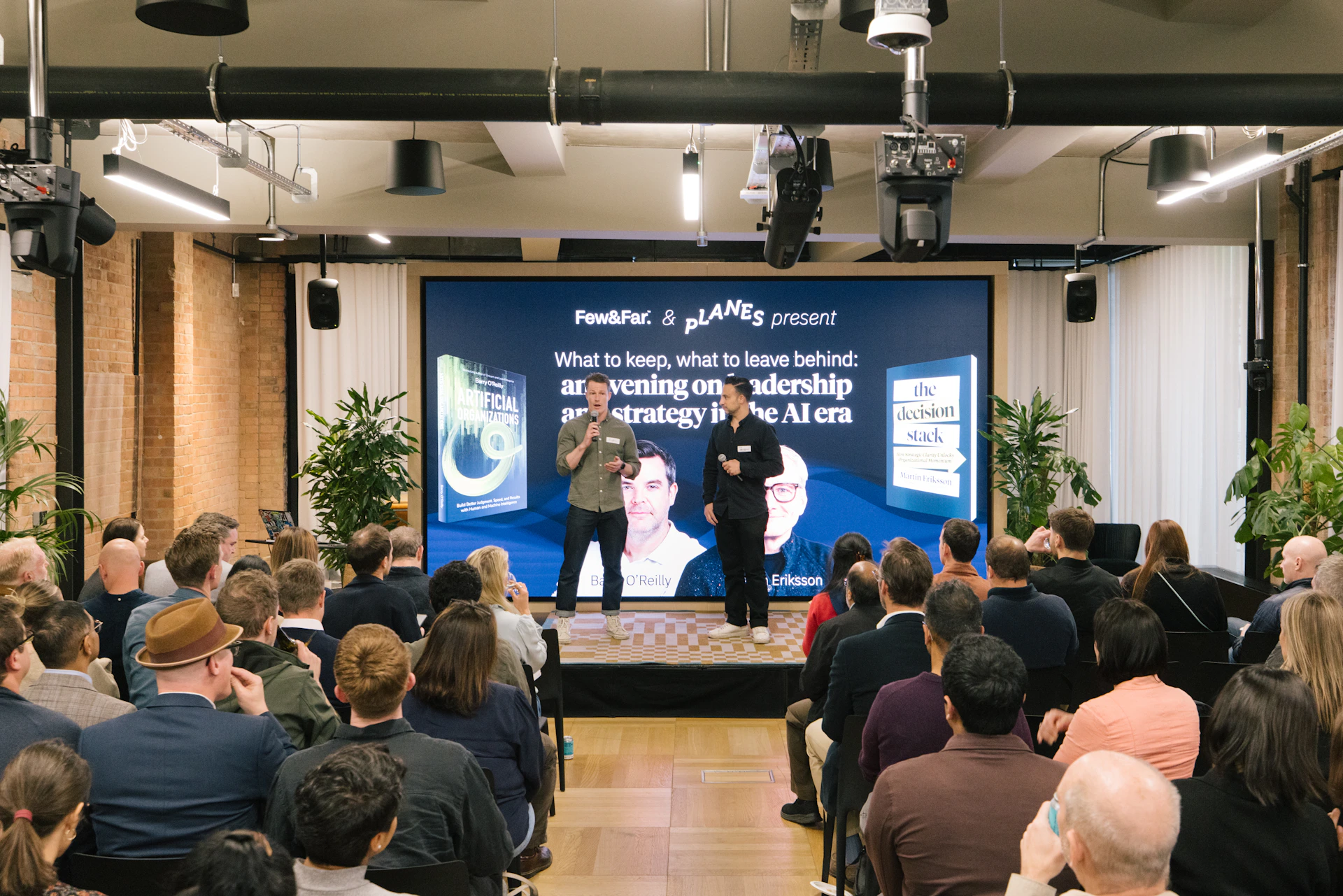
We sat down with Martin Eriksson, founder of Mind the Product and author of The Decision Stack, and Barry O'Reilly, author of Unlearn and Lean Enterprise, to find out. Here are their three takeaways.
1. Lead the behaviour change
We hear it from a lot of leaders: they feel behind on the tools, and they want to get up to speed… privately. 70-80% of senior leaders say they want to learn one-on-one or in a small group.
The problem is that this doesn't help your team. You can't expect them to become AI-literate if you're modelling the behaviour behind closed doors or, worse, not getting your hands dirty at all.
You should be the best at using the tools. Whether it's building skills and automations or vibe-coding a prototype, you need to be the one modelling adoption.
Without that, you'll get a team using one mandated tool to do small tasks faster. But speed is now table stakes.
As Barry put it, the leaders making the most progress are the ones experimenting in the open. Show your teams how you’re using the tools, what you’re learning, and where they're freeing you up to focus on what really matters: staying close to the customer, figuring out the right problem to solve, and making the right bet.
2. Go after bigger problems, not cheaper versions of existing ones
Once you've equipped your team, the next move is direction. If AI has expanded the surface area of problems we can solve, which should we be pointing it at?
Most businesses are stuck pointing AI at the UI layer: chatbots, workflows, and internal tools. There's a place for those when you're learning the ropes, but they aren't where the real opportunity lies. The better question sits further up the stack - not at the interface, but at the business itself.
Take Intercom. Their per-seat SaaS model was being disrupted by AI. Instead of panicking, they asked what AI could enable them to do that wasn't possible before. The answer was: change the pricing model entirely. They launched a separate brand, Fin, and charged 99 cents per resolution instead of per seat - aligning their incentives directly with their customers.
So, like Intercom, a good place to start is by asking: what would your customers do if your product were 10x cheaper, 10x faster, or 10x more accessible? How does your business need to adapt?
3. Use AI to surface your business's edge
Arguably, the biggest shift is seeing AI for what it really is: an enabler.
Martin suggests the classic competitive moats are being reshuffled. Scale, process power, and switching costs are all eroding because everyone has access to the same models.
What's left? Distribution, proprietary data, domain expertise, and brand. None of these have anything to do with AI. They're long-term investments that compound, and they matter more, not less, in an AI world.
So when you're thinking about where the opportunity is, look to your durable moats. Ask how AI could surface the value in things AI itself can't give you. It can't make you an expert, but it can get your expertise in front of every customer, instantly. It can't earn you trust, but it can deliver on the trust you've already built.
Delphius: the AI-powered platform from Lewis Silkin and Ius Laboris that delivers instant, sourced, jurisdiction-specific employment law guidance is a good example. The model behind the service is general-purpose; anyone can spin up an LLM. What makes Delphius defensible is what's underneath: decades of curated legal expertise across 50+ jurisdictions, kept current by expert lawyers across the alliance's global network. The AI is the new interface. The moat is the IP.
Now, the question to ask is this: what proprietary data, what domain expertise, what hard-earned trust does your business already have, and how could AI put it to work in ways that weren't possible before?
Product thinking matters more than ever
All of this paints a much more positive picture than we've been used to. More demand. Better problems. A bigger surface area for product thinking, not a smaller one.
Because the fundamentals haven't moved. Product has always been a decision-making discipline: figuring out which problems are worth solving, for whom, in a way that costs your business less than the value those customers get back.
What AI has done is open that equation up at both ends. The cost of solving problems has collapsed. The room to do something genuinely new is bigger than it's been in a generation. And the decisions about which problems to chase matter more than ever.
FAQs
Where should business leaders start with AI?
By using it themselves, in the open. 70-80% of senior leaders say they want to learn about AI privately, but that doesn't help their teams become AI-literate. The leaders making the most progress are the ones experimenting visibly, sharing what they've tried, what worked, and what didn't.
What is Jevons paradox and why does it matter for AI?
Jevons paradox is the idea that when the cost of something falls, demand goes up, not down. Cheaper steam engines didn't lead to less coal use. They led to vastly more. The same pattern is playing out with AI: cheaper, faster work doesn't mean we need fewer people. It means more problems become worth solving, and we need more people to solve them.
Will AI replace product managers and other knowledge workers?
The historical evidence suggests not. Ten years ago, Geoffrey Hinton predicted AI would replace radiologists within five years. AI did transform medical imaging. But there are now 60% more radiologists in the US than there were a decade ago. Roles change, but demand grows.
What kinds of competitive moats matter most in an AI world?
Distribution, proprietary data, domain expertise, regulation, and brand. The classic moats (scale economies, switching costs, process power) are eroding because everyone has access to the same models. The durable advantages are the ones AI can't give you, which means they matter more, not less, in an AI world.
What's an example of a company using AI well?
Intercom rebuilt their business model around AI, launching a separate product, Fin, that charges 99 cents per resolution instead of per seat, aligning their incentives with their customers. And Lewis Silkin built Delphius, an AI-powered platform that surfaces decades of curated legal expertise on demand. In both cases, the AI isn't the moat. It's the new interface to a deeper advantage the business already had.