Why is AI still so bad at making on-brand presentations?
By Malachy Bell - 5 November 2026
5 Min Read
It's Monday, and your team needs a deck for Thursday. Instead of starting from the approved brand slides, they now turn to AI: Copilot, Claude, Gamma, or whichever tool is flavour of the month.
They type a decent prompt, and forty seconds later there are slides. Some are kinda ok, but ultimately they miss the mark. So they find the deck a colleague used last quarter (not the brand template, which feels like too much of a blank slate), duplicate it and start tweaking. And so the cycle continues.
A 2026 think-cell survey of 1,200 professionals found 80% use AI somewhere in their presentation workflow, but only 14% of the European respondents were happy with AI building a whole presentation from scratch. Everyone expected AI to have fixed this by now, and it hasn't.
We could debate whether anyone will still need slideware in a few years' time, when our agents are running things and we're living it up on Universal Basic Income. For now, though, presentations are here to stay, and someone still has to make them.
And if there's no quick fix, what can you do? Deck creation comes up in almost every AI transformation conversation we have, so we took the challenge on ourselves. Here's what we learned.
What's stopping AI from making decks you'd actually send?
The tools are built to generate something new, but most of what makes a good deck is material you've already written, checked and approved. The problem is AI either can't see it or sees all of it and can't tell the approved brand template from last year's draft. So it guesses, gets it wrong, and you go back to copying an old deck.
The cycle repeats with every new presentation, and the cost adds up. Hours go on rebuilding slides that already exist somewhere. The brand erodes a little with every copy, and marketing ends up policing every template. Out-of-date numbers end up in front of prospects, and once a buyer spots one, they start to wonder what else is wrong.
And the stats back it up: 39% of presentations start from an old deck rather than the brand template, and 47% break the company's own design guidelines.
So is there a solution?
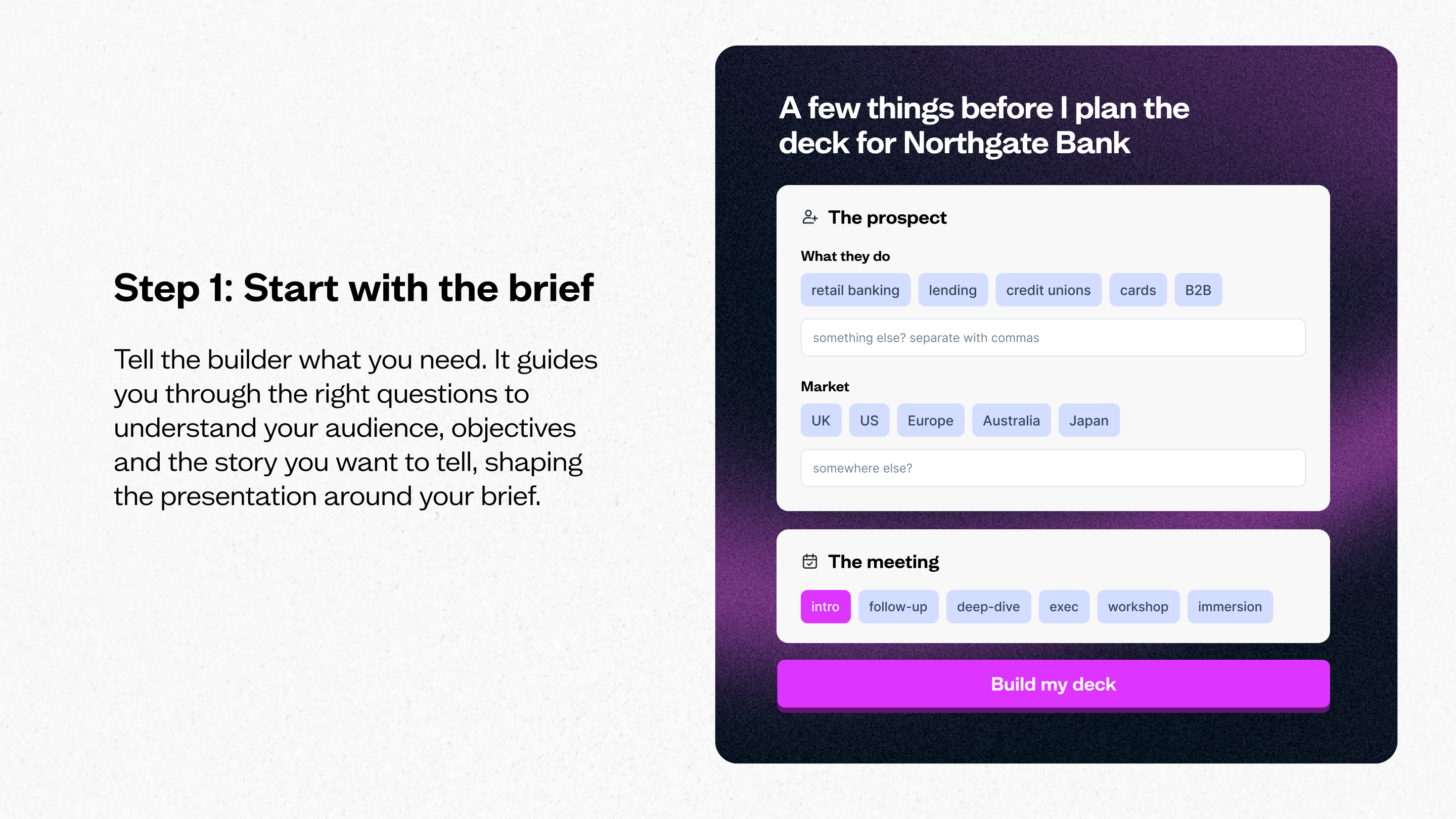
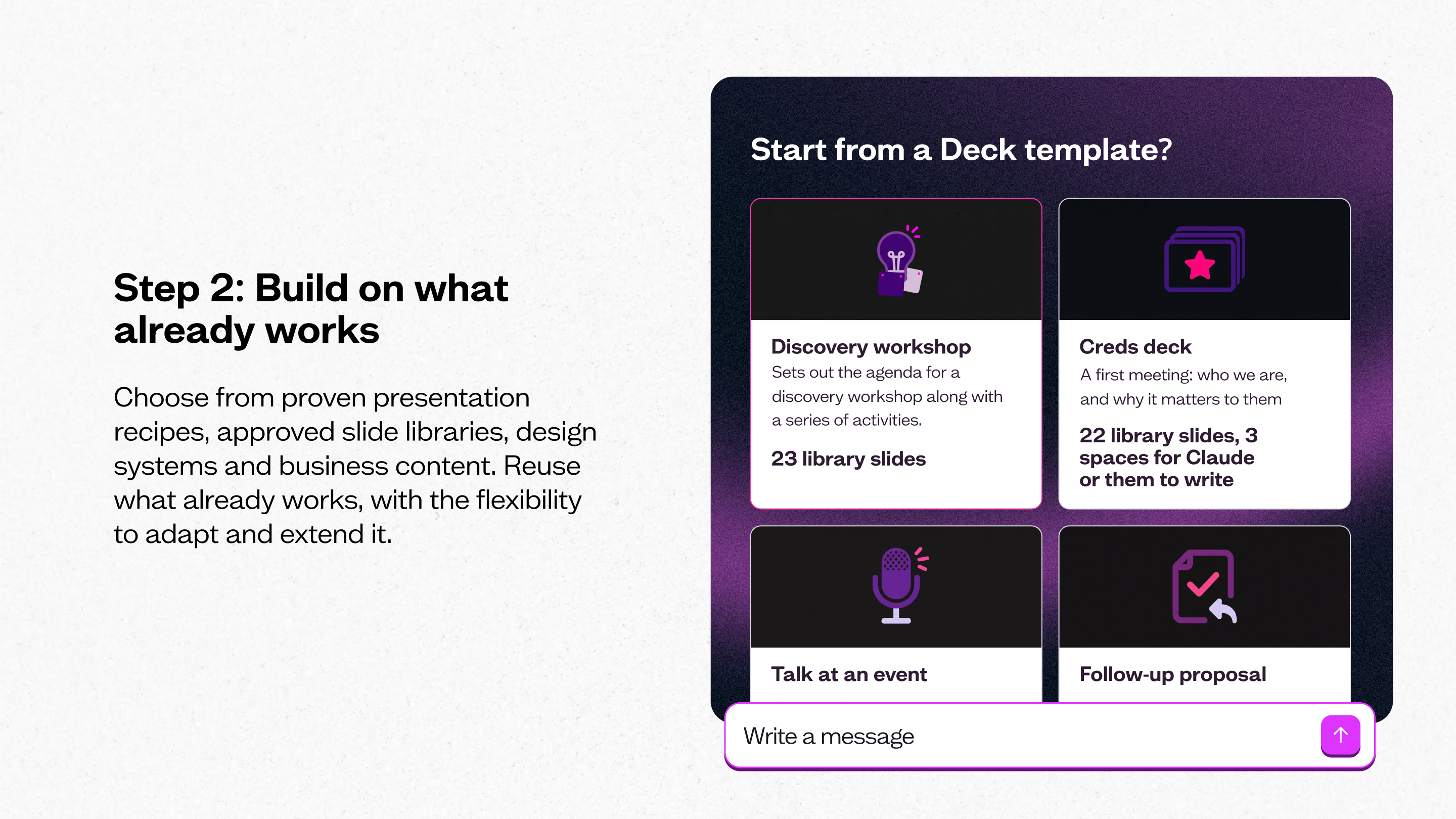
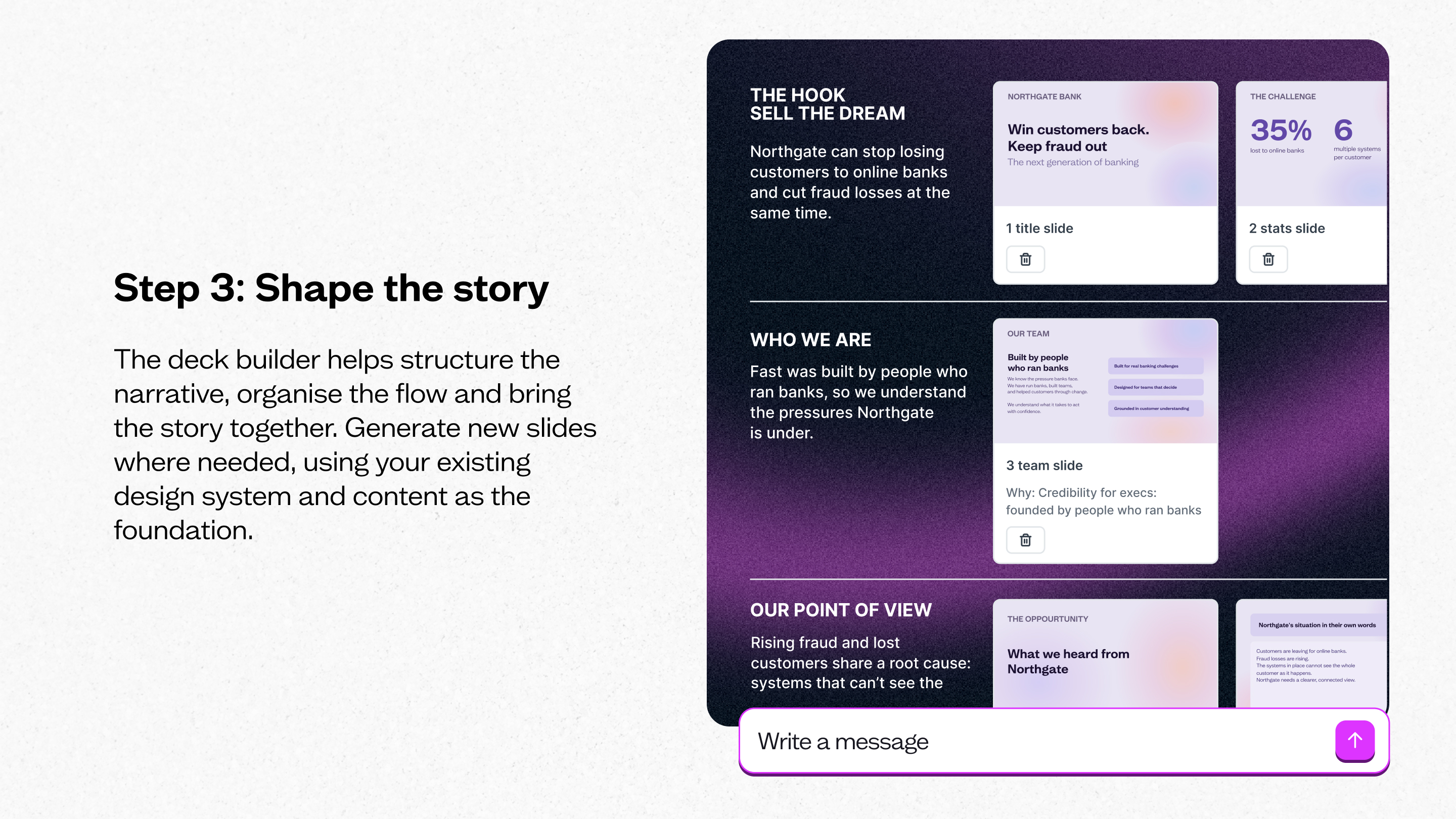
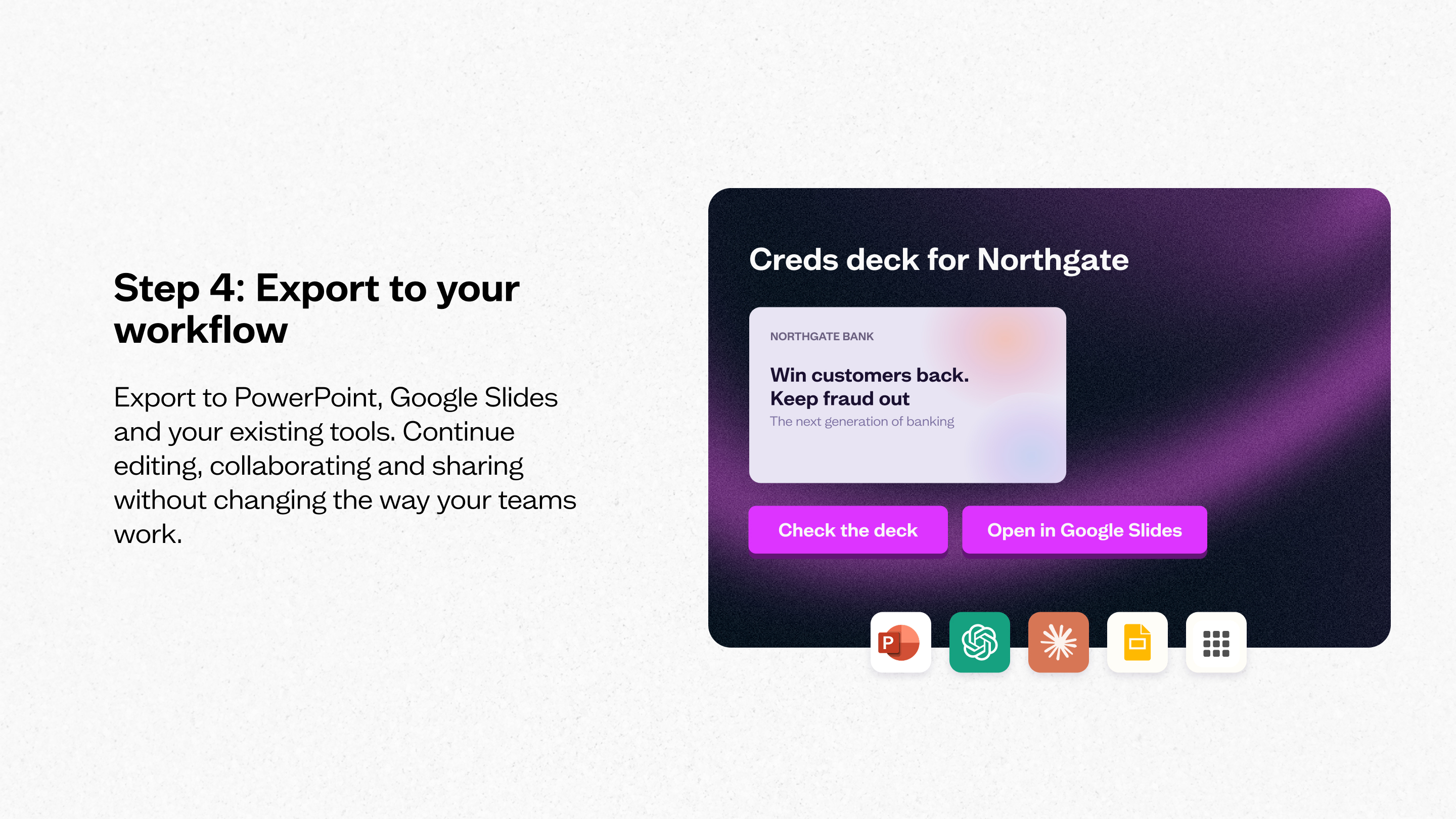
There is, and we've built it. Agree the brief and storyboard in a few prompts, and you'll have a finished, editable, on-brand deck about a minute later. But you can't shortcut your way to the shortcut, and there's some tedious work to do first (sorry).
Someone has to gather your best decks and sort the approved slides from the out-of-date and off-brand ones. Each slide needs tagging, the numbers need confirming, brand rules need writing down, and named owners need to be agreed.
AI can do a decent first pass, sorting most slides by market, product and audience and flagging numbers that look out of date. A human still needs to approve them, so we built an approvals interface to make that review as painless as possible. Each owner sees one slide at a time with the AI's suggested tags filled in, and swipes it into the library or out, like Tinder for your slides. It's still manual work, but people can chip away at it between meetings.
Once you've done the manual labour, you leave AI with the easiest bit. Its job shrinks from "write me a deck" to "build this from material we already trust".
How it works
Who is it most useful for?
Global sales and partnerships teams
A B2B SaaS company selling in dozens of markets has the same headache as a consumer brand juggling hundreds of sponsorship deals. Lots of people make decks, all the time, and every one has to carry the right numbers and reflect the current brand. A wrong stat in front of a prospect or sponsor does far more damage than a slow deck.
To solve this, you need assembly rather than generation. Pre-approved slides are tagged by market, product and audience, and the model picks and orders them without rewriting any approved content, so a rep has a first deck in minutes. When someone copies a deck, it gets checked against the same source of truth, so the numbers stay right however far it travels.
Luxury and ultra-high-net-worth
Private banks, wealth managers and luxury sales teams win work on how personal a proposal feels, so small teams of writers and designers build each one by hand. Years of past work are underutilised, because nobody can find the right piece in time and the knowledge lives in a few people's heads.
To solve this, you need to turn that back catalogue into something the AI can draw on. Past proposals get broken into reusable blocks, with every passage and image tagged. The AI composes a strong first draft, and the team spends its time on the details that make the client feel known.
Consultancies and agencies
Consultancies and agencies pitch for a living. Their proposals follow a familiar shape, but each one needs to look as if it was made for that client. A rigid template kills that, and a blank page every time is slow.
To solve this, you need to pair curation with creation. The design system, structure and house style stay fixed; the layout and narrative are built fresh for each pitch. An LLM connects to your design system and a library of past proposals, then drafts each one in your house style, shaped around whoever you're pitching to. It's how we build our own proposals at Planes, using Claude Design.
Decks are one of many workflows we're fixing with AI
We're helping businesses across insurance, travel, legal, utilities, healthcare and more. Every project starts with an Alpha Sprint, which gives you a technically robust prototype built and tested on your own material and a business case you can take to your board.
If decks, or any workflow like them, are slowing your team down, email me at malachy@planes.agency for a chat about how we can help.